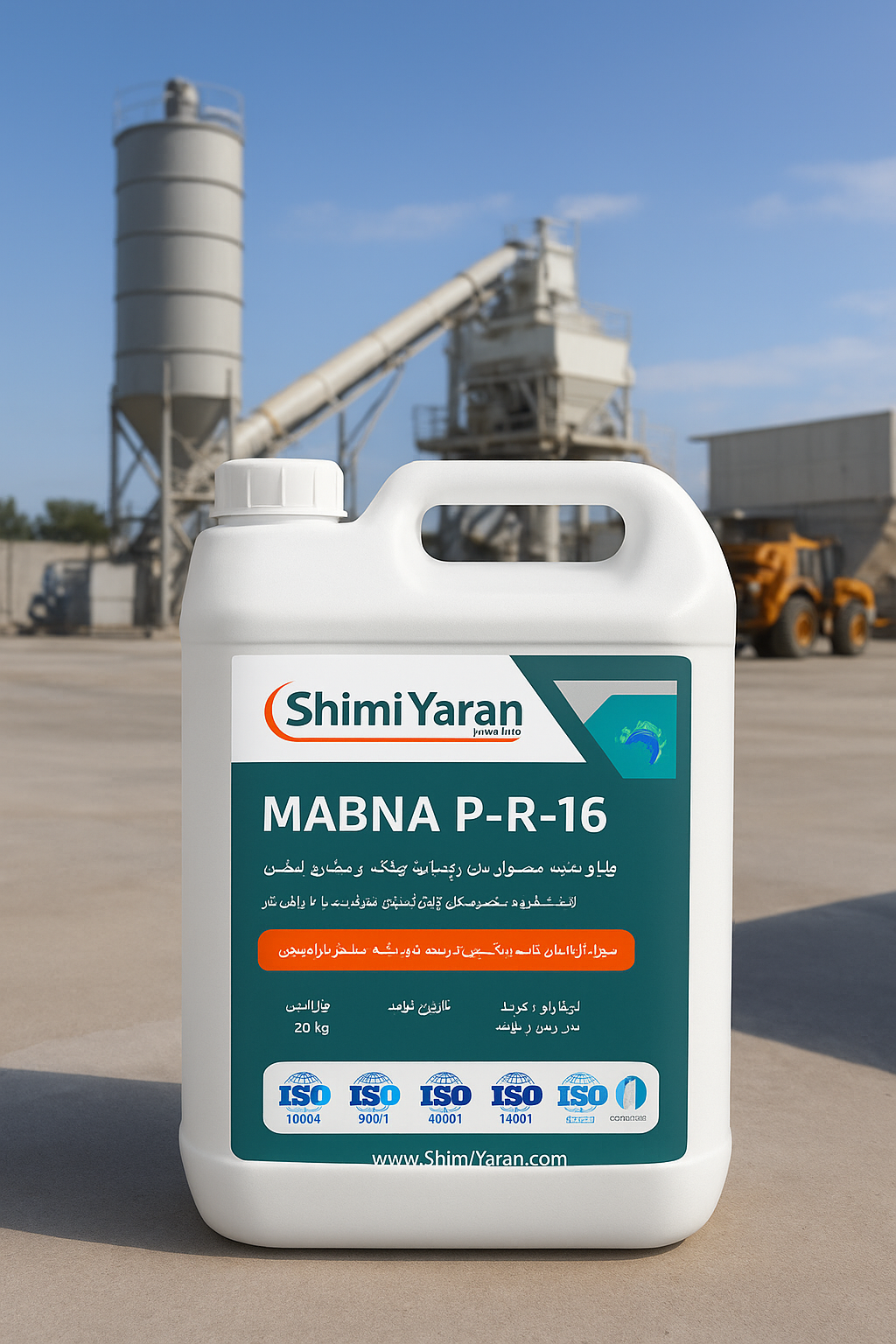
simultaneous impact on multiple properties of both fresh and hardened concrete. According to international and national standards, a high-range water-reducing/superplasticizing admixture is defined as a material that, without altering workability, significantly reduces the mixing water content, or, without changing the water content, markedly increases slump or flow, or achieves both effects simultaneously. MABNA P‑N‑17 is a fourth-generation high-performance, polycarboxylate‑ether‑based concrete superplasticizer developed by the Research and Development unit of the Polycarboxylate Resin Production Division at Shimi Yaran Alvand Company. This product has been designed to produce concrete with a low water-to-cement ratio and high workability, and also demonstrates excellent performance in the production of self-compacting concrete (SCC).
Main Applications:
- Execution of various structural elements, including piles, foundations, columns, walls, and slabs, with uniform compaction and high-quality surface finish.
- Production and placement of prestressed and precast concrete with optimal workability and minimal air entrainment.
- Enhanced effectiveness in injecting cementitious grouts such as soil nailing grout, shotcrete, and soil stabilization works through improved penetrability and adhesion.
- Construction of water-retaining structures and low‑permeability concretes for use in tanks, canals, and projects in direct contact with surface and groundwater.
- High compatibility with pozzolans and blended cements to improve mechanical properties and concrete durability.
- Capability to produce self‑compacting concrete (SCC) and exposed concrete with uniform, void‑free surfaces and a desirable visual finish.
- Increased concrete flowability while maintaining cohesion, preventing segregation, and ensuring strong adhesion during placement.
- Reduction of the water‑to‑cement ratio alongside high slump, resulting in high compressive strength at both early and final ages.
- Acceleration of concreting and formwork stripping, shortening execution time and reducing construction costs.
- Improved concrete durability under severe environmental conditions by reducing chloride and sulfate ingress, enhancing abrasion resistance, and increasing performance in freeze‑thaw cycles.
Advantages:
- Significant reduction of mixing water and water-to-cement ratio: Decreases mixing water content by up to 30%.
- Enhanced flowability and slump retention: Produces high-slump concrete even at low water-to-cement ratios, while extending workability time.
- Improved mechanical properties and durability: Increases compressive strength at both early and final ages, boosts abrasion resistance, and enhances performance under freeze–thaw cycles.
- Reduced permeability and improved watertightness: Minimizes penetration of chloride ions, sulfates, and water by lowering the water-to-cement ratio.
- Improved integrity and cohesion of concrete: Produces cohesive concrete with no segregation, preventing creep and minimizing shrinkage.
- Ease of placement: Facilitates pumping and reduces equipment wear.
- Wide compatibility: Compatible with all types of Portland cements and pozzolanic materials without altering concrete setting times.
- Economic efficiency: Allows cement savings of 10–20% depending on materials and mix design, without compromising strength.
- Safety and environmental compatibility: Free of chlorides and other steel- and concrete‑damaging ions; non‑toxic and non‑flammable
Storage Conditions:
- Shelf life: One year when stored in the original, unopened packaging under suitable conditions.
- Recommended storage temperature: Between +5 °C and +35 °C.
- Protection requirements: Keep away from frost and direct sunlight.
- Packaging: Available in 20 kg plastic containers and 1000 kg IBC tanks.


Reviews
There are no reviews yet.